
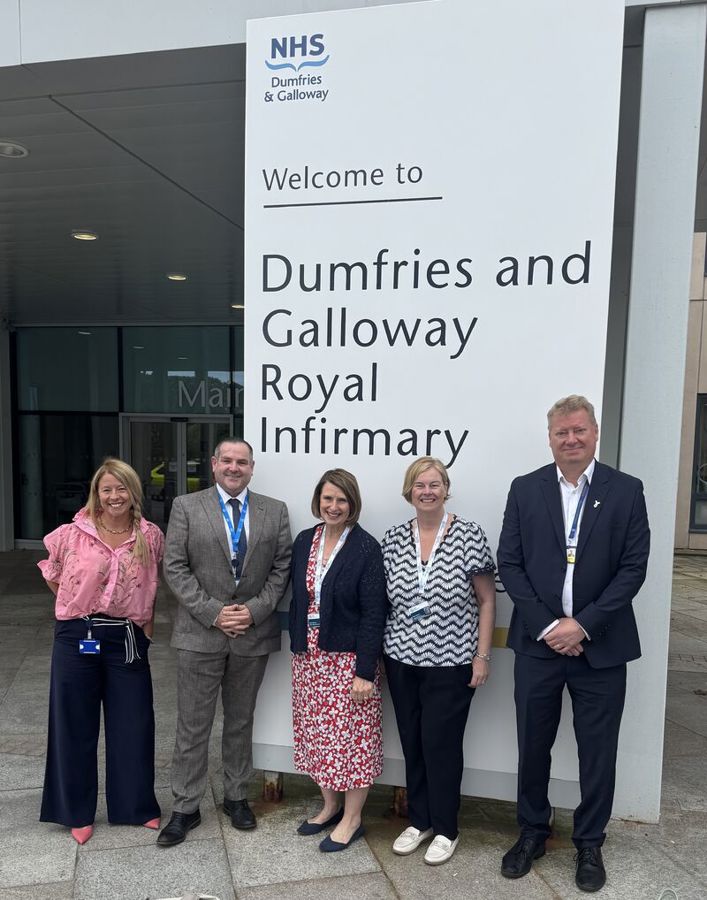
I’ve just spent two days with colleagues at NHS Dumfries and Galloway, and I’ve come away thinking about something that doesn’t get said nearly often enough.
Rural healthcare in Scotland runs on the determination, adaptability and commitment of the people delivering it.
Too often we talk about rural medicine as if its simply urban healthcare delivered in a different postcode. It isn’t. Rural healthcare is a discipline in its own right. Smaller teams cover vast geographical areas. Staff often work with fewer immediate resources, less specialist backup and greater distances between patients and definitive care. Every decision carries a different context.
What struck me again this week was the impact of social care capacity on frontline healthcare teams.
When we discuss delayed discharge, we often focus on hospital beds and patient flow. But what is less visible is the effect these pressures have on community services. In some areas, community nurses are spending a significant proportion of their time filling gaps that exist because social care capacity simply isn’t there. In some cases, that can amount to as much as half of their workload.
That isn’t what community nursing was designed to be.
Instead, highly skilled clinicians are absorbing wider system pressures, taking on responsibilities because there is no alternative and because the people they care for still need support.
Across the two days, I was struck by the honesty of the conversations I had with staff. What I heard wasn’t frustration directed at individuals. It was concern about the cumulative impact of structural challenges that have become normalised.
The reality is that many rural healthcare professionals are carrying the weight of multiple system pressures simultaneously. They are managing increasing demand, workforce challenges, geographical constraints and gaps elsewhere in the health and care system. And they continue to do so with remarkable professionalism and commitment.
That commitment deserves recognition. But it should not be mistaken for sustainability.
When social care remains under-resourced, the consequences do not disappear. They are felt by patients, families, communities and the healthcare professionals who step in to bridge those gaps. In rural Scotland, those consequences can be particularly acute.
As Scotland thinks about the future of healthcare and patient safety, rural inequality and the social care challenges that underpin so many of these issues cannot remain peripheral concerns. They are fundamental to whether people can access safe, equitable and timely care.
If we are serious about improving patient safety, then we must be equally serious about addressing the underlying pressures that rural services face. Goodwill, professionalism and dedication have carried the system a long way. But they cannot be the long-term solution.
My sincere thanks to everyone at NHS Dumfries and Galloway who gave their time, shared their experiences and spoke so openly over the last two days.
Your insights matter, and your commitment to your communities is impossible to miss.
Updated version originally published on Karen Titchener's LinkedIn
[Image description: Photograph taken outside Dumfries and Galloway Royal Infirmary. Five people, including Karen Titchener and Moira Manson, are standing in front of a large white NHS Dumfries and Galloway sign that reads “Welcome to Dumfries and Galloway Royal Infirmary”. The hospital entrance, glass doors and building façade are visible in the background. The group is posed for a formal photograph on a paved area outside the hospital.]
